
HMNZS Leander
Leander was laid down by Devonport Dockyard in September 1930. She was launched on 24 September 1931 and commissioned on 23 March 1933.
In April 1937, Leander arrived in New Zealand from the United Kingdom.
Prior to the outbreak of war in 1939, Leander received new four-inch twin gun mounts to replace the single mounts. She was also fitted for the Walrus amphibian carried amidships on a platform behind the stack.
30 August 1939. HMNZS Leander carries the first unit of the New Zealand Army to be sent overseas. The unit was No. 1 Platoon, 'A' Company, which was a detachment of two officers and 30 other ranks gleaned from the Regular Force.
March 30th, 1942. HMNZS Achilles Sailors and HMNZS Leander Sailors take a break in Fiji when seven weeks of mail arrives for both ships via an exchange with the USS San Francisco. Both crew turn up to sort out the mountain of letters from home.
On June 5 1943 Leander replaced the Trenton in a convoy departing Bora Bora harbour in the Society Islands. The international dateline was crossed on June 10, arriving in Numea, New Caledonia on June 12.
13 July 1943. Leander carrying 700 on board is with a flotilla of 12 boats including the Honolulu and the St Louis, which are attacked by 7 Japanese. The first Japanese torpedoes sink one destroyer, hit the Leander amidships and destroy the bow of another cruiser (See the logs from the USS Nicholas). Leander is severely damaged with an engine room, a boiler room and a 4-inch gun destroyed. After making temporary repairs Leander proceeded to Boston, USA for major restoration and a refit.
On July 19, 1943 The New Zealand Herald carried a report - Casualties at Kula Gulf
By May 1944 when she reverted to the Royal Navy, Leander's Armament included six 6 inch, eight 4 inch, two quad Bofors, three twin and four single 20mm guns.
Her final outfit in late 1946 saw the replacement of the quad Bofos by two twin mounts, the loss of all single and one twin 20mm gun and the fitting of three single Bofors.
Leander was returned to the United Kingdom in 1944 and was sold for scrap on 15 December, 1949.
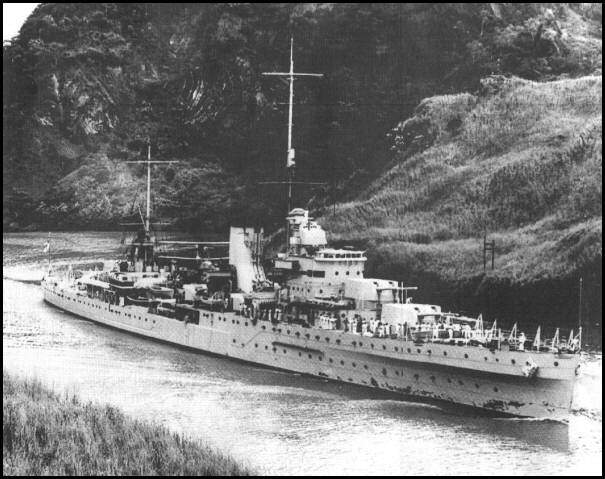
Leander in Panama Canal (Gaillard Cut) possibly 1943.
|
Specifications |
|
|
Displacement |
7,270 tons |
|
Length |
554.5 feet (oa) |
|
Beam |
55 feet 2 inches |
|
Draught |
16 feet (4.88m) mean |
|
Armament |
8 by 6 inch |
|
8 by 4 inch |
|
|
4 by 3 pdr |
|
|
10 smaller |
|
|
Armour |
Sides 2 - 4 inch (51-102mm) |
|
Turrets 1 inch (25mm) |
|
|
Deck 2 inch (51mm) |
|
|
Control tower 1 inch (25mm) |
|
|
Machinery |
Admiralty 3-drum boilers |
|
Parsons geared turbines |
|
|
Four shafts |
|
|
72,000 shp |
|
|
Speed |
32.5 knots |
|
Compliment |
550 |